Same Thing, Every Morning: Why Japanese Families Swear by Repetition—and What It's Costing Us to Keep Reinventing Ours
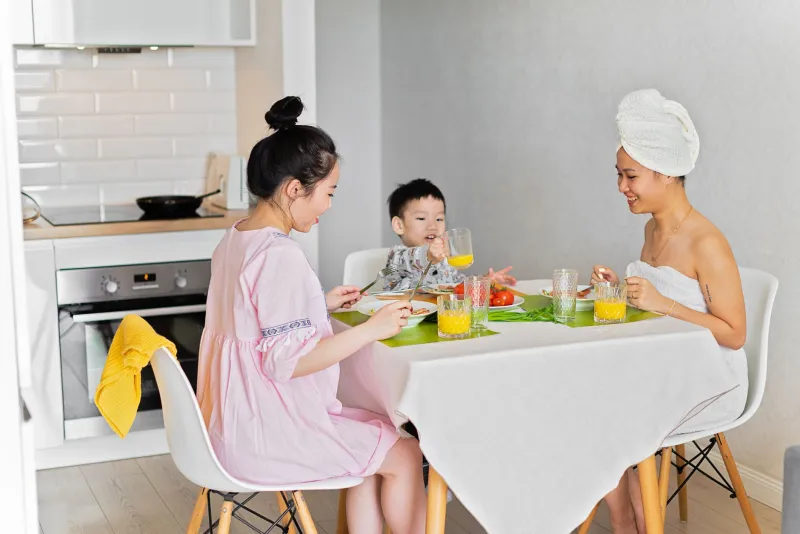
Somewhere around Tuesday of last week, you probably stood in your kitchen trying to decide what to make for breakfast. Not because you were hungry for something specific. Not because the kids had asked for anything. Just because it felt like you should mix it up a little. Keep things interesting. Avoid the rut.
That low-grade pressure to constantly rotate, refresh, and optimize even the most ordinary moments of family life? It's exhausting. And according to a concept deeply embedded in Japanese culture, it might also be completely backwards.
What Kata Actually Means
Most Americans have heard the word kata in the context of martial arts—those precise, choreographed movement sequences that karate students drill over and over until they're second nature. But kata is far bigger than a dojo. In Japanese culture, the idea extends into everyday life: the disciplined, mindful repetition of a set form until it becomes not just habit, but expression.
A tea ceremony master doesn't improvise the order in which she folds the cloth. A sushi chef doesn't decide each morning whether to cut fish differently today. A calligrapher doesn't freestyle the brushstroke. The form is the practice. The repetition is the point.
And in Japanese family homes, this philosophy quietly shapes everything from how mornings unfold to how the house gets cleaned before the new year.
The Breakfast That Never Changes
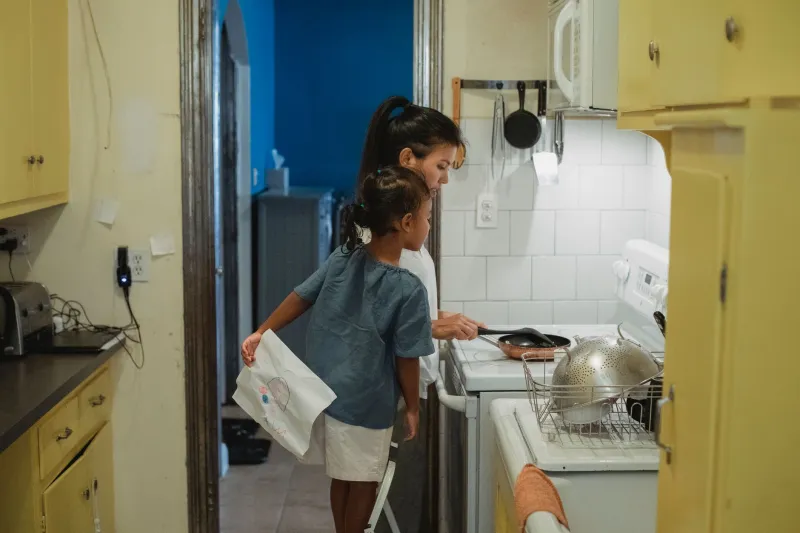
In many traditional Japanese households, the morning meal follows a pattern so consistent it's almost ceremonial. Miso soup, rice, pickled vegetables, maybe a piece of grilled fish. The components might shift slightly with the seasons, but the structure holds. Everyone knows what's coming. Nobody negotiates. The kitchen runs like a quiet, well-rehearsed performance.
Compare that to a typical American household morning, where breakfast might mean scrolling through a recipe app, arguing about whether anyone wants eggs, and ultimately just grabbing whatever's easiest because there's no time left. We optimized ourselves right into chaos.
The Japanese approach isn't about deprivation or rigidity. It's about removing a category of decision entirely so that the morning can be spent on something more valuable—like actually talking to the people sitting across from you.
Decision Fatigue Is Real, and Your Family Is Feeling It
Neuroscientists have been making this case for years. The human brain has a finite capacity for decision-making in a given day, and every small choice—even trivial ones like what to eat or which mug to use—draws from the same cognitive reservoir. By the time parents hit the really important decisions of the day, that reservoir is shallower than it should be.
This is part of why figures like Barack Obama and Steve Jobs famously wore near-identical outfits every day. Not as a fashion statement, but as a deliberate removal of one decision from the daily pile. They understood, intuitively, what kata practitioners have known for centuries: limiting choices in low-stakes areas frees up mental energy for high-stakes ones.
For families, the stakes of that trade-off are even higher. When parents are cognitively depleted by noon, it shows up in shorter tempers, less patience during homework time, and a reduced capacity to be emotionally present with their kids. A predictable breakfast routine isn't boring. It's protective.
Why Americans Are Wired to Resist This
Here's the cultural tension: American identity is deeply tied to reinvention. We celebrate people who disrupt industries, reinvent themselves, and refuse to be defined by routine. Novelty reads as ambition. Repetition reads as settling.
This shows up in parenting culture in particular. There's enormous social pressure—amplified by social media—to constantly be introducing your kids to new experiences, new foods, new activities, new everything. The enrichment arms race is real. And while exposure and variety are genuinely valuable, the pendulum has swung so far that many families have lost any stable center to return to.
Cultural anthropologists who study Japanese domestic life note that the predictability of family rituals functions as a kind of emotional anchor for children. Knowing that Sunday nights always mean curry, that the first Saturday of every month means cleaning out the genkan together, that bedtime always ends with the same three-minute routine—this consistency doesn't dampen a child's sense of wonder. It creates the safety from which wonder can actually launch.
The Bedtime Ritual as Kata
This is where the concept gets genuinely practical for American families. Think about bedtime. For many households, it's a nightly negotiation: How many books? Which ones? Who reads? Can I have water? One more song? The unpredictability isn't fun—it's a power vacuum that kids, being kids, will fill every single time.
Japanese families who follow a kata-style bedtime aren't running a military operation. It's softer than that. But the sequence is fixed: bath, pajamas, one story, lights out. The same order, the same rhythm. Children's nervous systems respond to this predictability in measurable ways—cortisol levels drop more reliably when the pre-sleep cues are consistent, which means kids actually fall asleep faster and sleep more deeply.
The parents benefit too. A predictable bedtime kata means the end of the evening isn't a battle. It's a choreography both sides know by heart.
Seasonal Cleaning as Ritual, Not Chore
One of the most striking examples of kata in Japanese home life is osoji—the deep cleaning that happens at the end of the year. It's not just tidying up. It's a structured, almost ceremonial process of clearing out the old before the new year arrives. Families do it the same way, at the same time, every year.
American spring cleaning is a similar impulse, but it tends to be reactive—we clean when it gets bad enough, or when we finally have a free weekend, or when company's coming. The Japanese version is proactive and calendrical. It happens because it's time, not because the mess demanded it.
What that regularity creates is a family rhythm that's larger than any individual. Kids who grow up doing osoji with their parents don't just learn how to clean. They learn that their family does certain things at certain times because that's who they are. Identity, embedded in repetition.
How to Actually Try This at Home
You don't need to overhaul your life. Start with one ritual—one small sequence that you commit to keeping the same for thirty days. It could be as simple as how Saturday mornings begin, or the specific order of your weeknight dinner cleanup. Write it down if it helps. Tell your kids this is how it's going to go.
Then notice what happens. Not to the ritual itself, but to the space around it. When one part of the day stops requiring negotiation, something loosens. Conversation fills the gap. Presence fills the gap.
That's kata at home. Not boring. Not limiting. Just the quiet, radical act of deciding that some things are worth doing exactly the same way, every single time—because the sameness itself is the gift.