Nothing Left Behind: How the Japanese Philosophy of Mottainai Is Quietly Reshaping American Family Life
Somewhere between the third uneaten yogurt cup and the drawer full of tangled charging cables that don't fit anything you still own, most of us have had the thought: we have too much stuff, and we're still wasting it. It's a peculiar contradiction of modern American life—abundance on one side, guilt on the other, and very little framework for bridging the two.
In Japan, that framework has a name. And it's been around for centuries.
So What Exactly Is Mottainai?
Mottainai (もったいない) is one of those Japanese words that resists clean translation. Roughly, it expresses a sense of regret or sorrow over waste—not just environmental waste, but the squandering of anything that still holds value. Food, objects, time, relationships. The feeling it describes is closer to grief than guilt. You're not just acknowledging that something was wasted; you're feeling the loss of its unrealized potential.
The concept draws from Buddhist ideas about the intrinsic value of all things, and it's been woven into Japanese domestic life for so long that most Japanese people don't think of it as a philosophy at all. It's just... how you were raised. You finish your rice. You repair the torn shirt. You find another use for the paper bag before you recycle it. Not because someone told you to. Because throwing it away without trying would feel like a small betrayal.
Activist Wangari Maathai famously brought the word to an international audience in the early 2000s, calling it a perfect summary of the reduce-reuse-recycle ethos. But for Japanese families, mottainai was never really an environmental campaign. It was dinner table culture.
The American Abundance Problem
Here's the thing about growing up in a culture of abundance: it quietly trains you to see disposal as a form of freedom. Didn't like it? Toss it. Outgrew it? Replace it. The upgrade is always available, the next version always better. That mindset isn't laziness—it's the logical output of a consumer economy built on the idea that new is better and more is more.
But there's a creeping exhaustion that comes with it. Researchers studying decision fatigue have found that the more choices we manage—including what to buy, what to keep, what to throw away—the more mentally depleted we become. American households spend real cognitive energy navigating their own excess. Closets become sources of low-grade anxiety. Pantries turn into archaeology sites. The average American family, according to UCLA's Center on Everyday Lives of Families, manages roughly 300,000 objects in their home. That number isn't just staggering—it's tiring.
Mottainai offers a different operating system. Not minimalism exactly, and not deprivation. More like intentionality with feeling.
What It Looks Like at the Kitchen Table
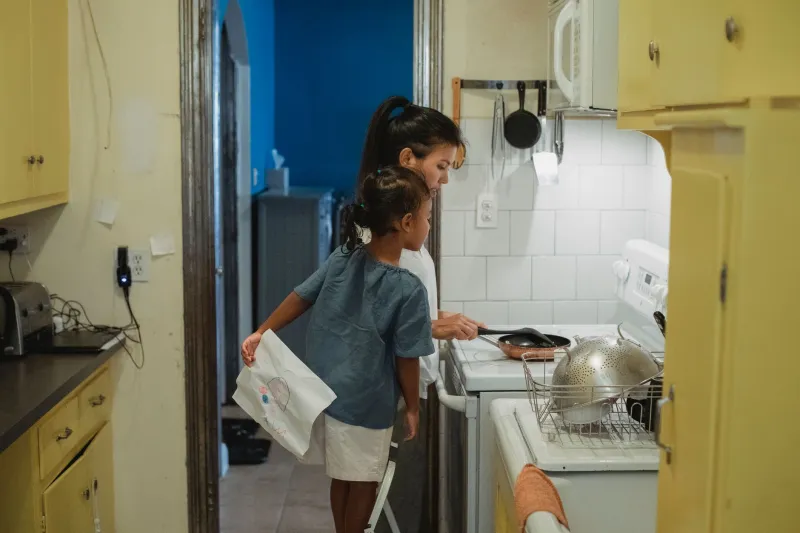
For families who've started weaving mottainai into daily life, the kitchen is usually where it begins. Japanese home cooking has always been oriented around using everything—fish bones become broth, vegetable scraps go into stock, leftover rice becomes the next morning's breakfast. Nothing exits the kitchen without being fully considered.
Take the concept of ichiju sansai—the traditional Japanese meal structure of one soup and three sides—which naturally limits portions and discourages overbuying because you're cooking in balance, not volume. American families who've adopted this loose framework often report something unexpected: mealtimes feel calmer. There's less negotiation, less waste, and somehow more satisfaction in the meal itself.
Amanda, a mom of two in Portland who started incorporating Japanese meal-planning principles after a trip to Kyoto, put it simply: "I used to shop for the week and throw out half of it on Sunday. Now I shop for two days at a time, use what we have, and my kids actually eat more because there's less on their plates." She laughs. "It sounds backwards. But it works."
Objects With a Second Life
Mottainai extends well beyond food. In Japanese households, objects are often repaired rather than replaced—a practice that sits in direct contrast to the throwaway culture most Americans grew up in. The art of kintsugi, repairing broken ceramics with gold-laced lacquer, is perhaps the most poetic expression of this: the crack isn't hidden, it's highlighted. The object becomes more interesting, more storied, because of its repair.
You don't have to be a ceramics artist to carry that spirit into everyday life. It can look like a father teaching his daughter to sew a button back on instead of buying a new shirt. It can look like a family rule that something gets fixed before it gets replaced. It can look like a garage shelf of glass jars repurposed as storage, or a worn wooden table that gets refinished instead of hauled to the curb.
For some American families, adopting this mindset has had an unexpected side effect: kids start valuing their things more. When something breaks and you fix it together, the object carries a memory. It becomes a little bit irreplaceable. That's mottainai working exactly as intended.
The Psychological Payoff Nobody Talks About
Beyond the environmental benefits and the tidier pantry, there's something subtler going on when families genuinely commit to a nothing-wasted approach. Gratitude, it turns out, is easier to access when you're paying attention to what you already have.
Psychologists who study consumption patterns have noted that the act of noticing the value in things—really pausing to acknowledge what an object does for you before you discard it—activates a kind of mindful appreciation that's genuinely good for mental wellbeing. Mottainai, in practice, is a daily gratitude exercise that doesn't require a journal or a morning routine. It just requires that you stop and think before you throw something away.
There's also the matter of decision fatigue, circling back. When your default is to use what you have and find value in what already exists, you're making fewer consumption decisions overall. Fewer trips to Target for things you sort-of need. Fewer impulse buys that clutter the counter and the mind. The mental load lightens in ways that are hard to quantify but easy to feel.
Starting Small, Without the Guilt Trip
The beautiful thing about mottainai as a family value is that it doesn't demand perfection. It's not a diet or a decluttering system. It's more of a question you start asking: Is there something more this could do before it's done?
Maybe that's a leftover half-onion that goes into tonight's soup instead of shriveling in the fridge. Maybe it's a worn-out backpack that gets patched instead of tossed. Maybe it's just pausing before you buy something new to ask whether something you already own could do the job.
For families raising kids in a culture that's always pushing the next thing, mottainai is a quiet counterweight. It teaches children that value isn't just about newness. That things—and time, and relationships—deserve to be used fully before they're let go.
That's a lesson worth keeping.