What Obaachan Knows That No Recipe App Ever Will
There's a particular kind of knowledge that doesn't travel well through screens. You can watch a YouTube tutorial on how to make your grandmother's miso soup seventeen times and still produce something that tastes like a reasonable approximation rather than the real thing. The ratio of dashi to miso might be technically correct. The tofu might be cut to the right size. But something will be missing—some small, intuitive adjustment that your grandmother makes without thinking, the kind of thing she couldn't explain even if you asked her directly because she learned it the same way: by standing next to someone who already knew.
In Japan, the person most likely to hold that knowledge is called obaachan—grandmother. And across generations of Japanese families, she has occupied a role in the kitchen that goes far beyond cooking. She is the keeper of the family's edible memory.
The Kitchen as Classroom
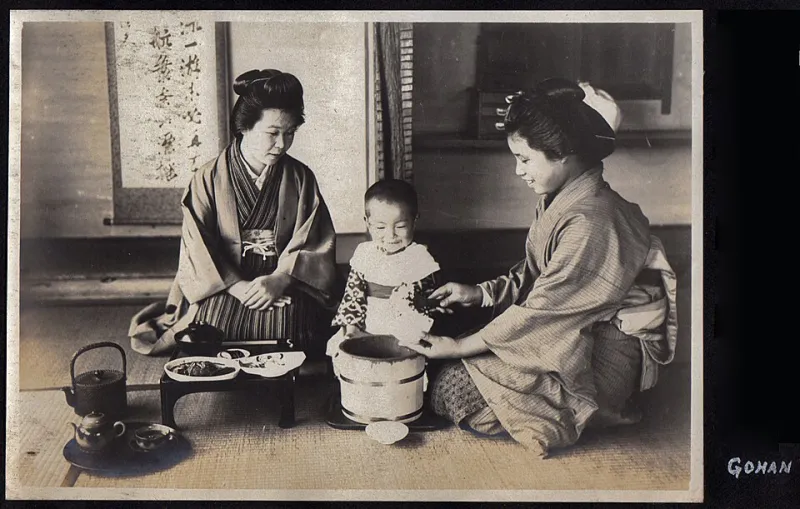
In many traditional Japanese households, the transmission of cooking knowledge isn't a formal event. There's no designated "recipe day." Instead, it happens through proximity and repetition over years, sometimes decades. A granddaughter helps wash rice as a small child, watches the soup get made as a teenager, and eventually takes over a dish entirely as a young adult—not because she was taught in any structured sense, but because she absorbed it through presence.
This model is sometimes called minarai (見習い)—learning by watching. It's a concept that appears throughout Japanese apprenticeship culture, from sushi chefs to lacquerware artisans, but it lives most naturally in the domestic kitchen. The idea is that some knowledge is best transferred not through instruction but through immersion. You don't just learn the recipe; you learn the rhythm, the smell, the feel of the dough at the right moment, the sound of the broth when it's ready.
Kumiko, a 34-year-old Japanese American woman living in Chicago, describes learning to make her grandmother's nikujaga—a hearty meat-and-potato stew—this way: "She never measured anything. I'd ask her how much soy sauce and she'd say, 'enough.' I'd ask how long to cook it and she'd say, 'until it smells right.' I was frustrated at first. But after I made it with her maybe ten or twelve times, I just... knew. I can't explain it either now. I just know."
That kind of embodied knowledge—the knowledge that lives in your hands and your nose rather than on a recipe card—is exactly what gets lost when cooking traditions skip a generation.
What Makes Obaachan's Role Distinct
In Japanese culture, the grandmother's authority in the kitchen isn't just practical—it's relational. She is often the emotional center of the extended family, and the kitchen is where that centrality expresses itself most clearly. Holidays, family gatherings, and seasonal celebrations all orbit her cooking. Her osechi ryori (the elaborate New Year's dishes) or her particular version of ochazuke become the taste of home itself, inseparable from the feeling of being safe and cared for.
This matters because food memory is among the most durable forms of memory we have. Neuroscientists have long noted the powerful link between smell, taste, and emotional recall—the so-called Proustian memory effect. When a dish is made the same way, in the same kitchen, by the same hands, year after year, it becomes a kind of anchor. It tells you who you are and where you come from in a way that no family photograph quite manages.
Obaachan's cooking also carries cultural specificity that resists standardization. Her miso soup isn't just miso soup—it's miso soup made with the regional variety of miso her mother used, seasoned the way her particular corner of Japan seasons things, adjusted for the vegetables available in her childhood that may not even appear in any cookbook. That specificity is the family's culinary fingerprint. Lose it, and something genuinely irreplaceable is gone.
The American Contrast
American food culture has traveled in almost the opposite direction. Over the past fifty years, the combination of processed convenience foods, the collapse of multigenerational households, and more recently the explosion of food delivery apps and meal kit services has steadily eroded the informal transmission of cooking knowledge between generations. Many Americans in their twenties and thirties report that they never learned to cook from a family member at all—they learned from YouTube, or they didn't really learn, and they order in most nights.
This isn't a judgment. The pressures that produced this situation—longer working hours, geographic mobility, the dissolution of the extended family as a living unit—are real and serious. But the result is a kind of cultural food amnesia that goes deeper than just not knowing how to make a particular dish. It's a loss of the relational experience that cooking together creates.
Dr. Carla Naumburg, a clinical social worker and author who writes about family connection, has noted that shared cooking is one of the most reliable ways families build what she calls "ordinary intimacy"—the low-key, side-by-side closeness that forms the actual fabric of family relationships. It doesn't require a special occasion or a meaningful conversation. It just requires being in the same kitchen, doing something together.
That's precisely what the obaachan model provides, and what the convenience-food model eliminates.
What Gets Passed Down Besides the Recipe
Ask anyone who learned to cook from a grandmother—Japanese or otherwise—what they actually received, and they'll usually tell you it wasn't primarily the recipe. It was something harder to name.
For Yuki, a 28-year-old in San Francisco whose grandmother taught her to make tamagoyaki (the rolled Japanese omelette), the lesson went beyond egg cookery: "She taught me to be patient. She'd say, 'Don't rush the pan.' I think about that now when I'm stressed about other things. Don't rush the pan."
For Marcus, a 40-year-old in Atlanta who learned Southern cooking from his grandmother and has since developed a deep interest in Japanese food culture through his Japanese American wife's family, the parallel is striking: "My grandma never used a recipe either. It was all feel and memory. When I watch my mother-in-law cook with her mom, I see exactly the same thing. The recipe is almost like a pretext. What's really happening is that they're spending time together and passing something on."
The recipe is the vehicle. The relationship is the destination.
Reclaiming the Tradition—Even If You Have to Start From Scratch
If you didn't grow up with this kind of cooking transmission—and many American families didn't—it's not too late to start building it, even if you have to begin in the middle rather than at the beginning.
Call the family member who still cooks from memory—a grandmother, a great-aunt, an older parent—and ask if you can cook with them rather than just eating what they make. Bring a notebook, but don't rely on it. Pay attention to the things they can't explain: the way they hold the knife, when they taste the sauce, how they know when something is done. Those are the things worth learning.
If that person is no longer around, consider this an invitation to become the one who starts the tradition. Choose two or three dishes that matter to your family—dishes tied to holidays, to places, to people—and make them repeatedly, with your children or younger relatives present. Let them help even when it's slower and messier. The point isn't efficiency. The point is that someday, when they're standing in their own kitchen trying to remember how something tasted, they'll know.
That's what obaachan has always understood. The recipe is never just the recipe. It's a way of saying: this is who we are, this is where we come from, and I want you to carry it forward.
No app has figured out how to say that yet.