Around the Shokutaku: What Japanese Dinner Tables Teach Us About Staying Connected as a Family
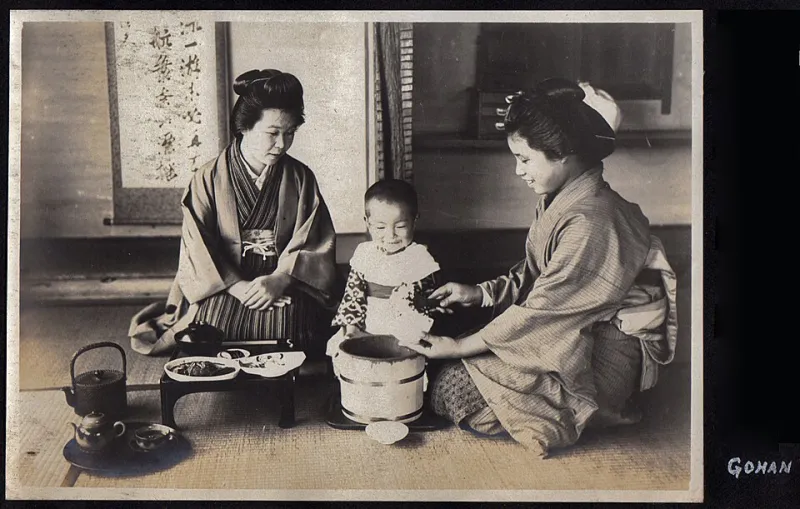
Photo: A.Davey from Portland, Oregon, EE UU, CC BY 2.0, via Wikimedia Commons
Picture this: It's 6:30 on a Tuesday night. In one house, four people are eating in four different rooms—one at the kitchen counter scrolling TikTok, one on the couch with a bowl of cereal, the kids in their rooms with headphones on. In another house, a family of five is gathered around a low wooden table, passing small dishes back and forth, somebody laughing about something that happened at school, grandma refilling everyone's miso soup.
Both are real. Both are Tuesday nights in America in 2024. But only one of them feels like something worth holding onto.
For Japanese families, that second scene isn't a special occasion—it's Tuesday. The shokutaku, or family dining table, holds a cultural weight in Japan that goes far beyond just eating. It's treated as a kind of anchor point for the whole household. And as more Japanese-American families settle across the US, some of that tradition is quietly traveling with them.
More Than a Meal
The word shokutaku (食卓) literally translates to "dining table," but in Japanese culture, the concept carries a lot more meaning than the furniture itself. It represents the daily ritual of sitting down together, sharing food that someone prepared with care, and actually being present with the people you live with.
In Japan, family meals are often structured around a concept called ichiju sansai—one soup and three sides—which isn't just a nutritional framework. It's a way of organizing the table so that everyone has something in front of them, something shared in the center, and a reason to reach across and connect.
Keiko Tanaka, who moved from Osaka to Portland, Oregon, twelve years ago with her husband and two kids, describes it this way: "In Japan, the table is not optional. Even if we were tired, even if the kids had homework—we ate together. It was just what you did. It wasn't a big conversation every night. Sometimes it was quiet. But we were there together."
Her family kept the tradition after moving to the US, though she admits it took some adjusting. "American schedules are different. The kids have after-school activities until seven sometimes. But we just shifted dinner later. We didn't give up the table."
What the Research Actually Says
Keiko's instinct has some solid science behind it. Studies from Harvard Medical School and the American College of Pediatricians have found that children who eat regular family dinners show lower rates of anxiety, depression, and substance use. They also tend to have better academic performance and stronger communication skills.
A long-running study from Columbia University found that teenagers who had frequent family dinners were significantly less likely to engage in risky behaviors—and that effect held across income levels, family structures, and cultural backgrounds.
But here's the interesting part: it's not really about the food. Researchers consistently point out that it's the ritual that matters. The predictability of it. The fact that there's a time every day when everyone is expected to show up.
That ritual-first thinking is deeply embedded in the Japanese approach to the dinner table.
Respect Starts at the Table
One of the things Japanese-American parents mention most often is how the dinner table becomes a space where kids learn to read a room—a skill that's increasingly rare.
In Japanese households, mealtime comes with gentle but clear expectations: you wait for everyone to be seated before eating, you say itadakimasu (a phrase of gratitude before eating) and gochisousama deshita (a thanks after finishing), and you don't just bolt from the table the second you're done. You stay. You talk. You help clear.
These aren't rigid rules so much as rhythms. And according to families who've brought them to American homes, they have a way of spilling into other parts of family life.
"My daughter is ten and she's the most socially aware kid in her class—her teacher has said so multiple times," says Hiroshi Matsuda, a Japanese-American dad in the Chicago suburbs. "I don't think it's a coincidence. She's been sitting at a dinner table with adults who talk to each other and to her since she was a toddler. She learned how to listen."
The Phone Problem (Yes, We're Going There)
Ask any Japanese parent living in the US what the biggest threat to the family dinner is, and you'll get a pretty consistent answer: screens.
This isn't a Japan-versus-America thing—Japanese families deal with it too. But there's a cultural norm in many Japanese households that the dinner table is a no-phone zone, full stop. Not a suggestion. Not a "we try to do that." Just: phones don't come to the table.
For American families trying to reclaim the dinner ritual, this might be the single most effective place to start. Not a complicated new recipe, not a perfectly set table—just a basket by the door where everyone drops their phone before sitting down.
"We started the basket thing two years ago," says Mei Collins, who grew up in Tokyo and now lives in Austin with her American husband and three kids. "My husband was skeptical. Now he says it's his favorite part of the day. Dinner is the only hour where nobody is performing for an audience."
Small Moves That Actually Work
You don't need to overhaul your whole routine to bring some of this into your home. Here are a few low-barrier ways to start:
Start with one night a week. Don't try to do seven nights immediately. Pick one night—maybe Friday—and protect it. Consistency matters more than frequency at first.
Simplify the food, not the gathering. Japanese home cooking is often simple and fast. Rice, miso soup, a protein, some vegetables. The point isn't an elaborate spread—it's that everyone is present.
Add a small ritual. It doesn't have to be itadakimasu (though honestly, why not?). It could be going around the table and sharing one good thing from the day. Rituals create belonging.
Let kids help. In many Japanese households, even young children have a role—setting the table, pouring water, carrying dishes. Participation builds investment.
Stay at the table a little longer than feels natural. The best conversations at dinner often happen five minutes after you'd normally get up.
The Table as a Long Game
What Japanese families seem to understand intuitively is that the dinner table is a long game. You're not building a connection in any single meal. You're building it over hundreds of unremarkable Tuesday nights—over miso soup and leftover rice and conversations about nothing in particular.
That's the real lesson of the shokutaku. It's not about making dinner special. It's about making it consistent.
And in a culture that's increasingly fragmented by schedules, devices, and the general chaos of modern life, consistent might be the most radical thing a family can do.