Empty Space Is the Point: How the Japanese Idea of 'Ma' Is Quietly Changing American Living Rooms
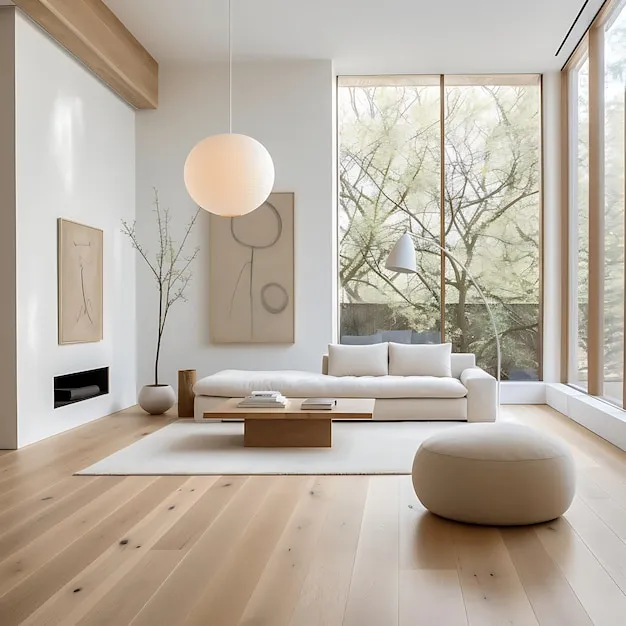
Photo: minimalist Japanese-inspired living room with natural light and simple wooden furniture, via img.freepik.com
Walk into most American homes and you'll find them full. Full of furniture, full of art on the walls, full of stuff accumulated over years of living. That's not a criticism—it's just how we tend to think about a well-decorated space. More is more, right?
But a growing number of homeowners across the US are starting to push back on that instinct. And they're finding inspiration in a Japanese concept that doesn't translate neatly into English: ma (間).
At its simplest, ma means negative space—the deliberate pause, gap, or emptiness between things. But calling it just "empty space" undersells it. In Japanese aesthetics, ma is not an absence. It's a presence. It's the breath a room takes. And once you start seeing it, you can't unsee it.
What 'Ma' Actually Means (And What It Doesn't)
The character 間 is made up of the symbols for "gate" and "sun"—light coming through an opening. That image gets at something essential. Ma is not about stripping a room bare or making it feel sterile. It's about creating intentional openings that let meaning, light, and calm flow through.
In traditional Japanese architecture, you see ma everywhere: in the wide-open floor plans of a washitsu (Japanese-style room), in the careful placement of a single flower arrangement in a tokonoma alcove, in the way a sliding shoji screen filters afternoon light into something almost poetic.
The concept extends beyond design, too. In music, ma is the rest between notes. In conversation, it's the meaningful pause. But for our purposes—and for the American homeowners quietly rethinking their living spaces—it's most useful as a design philosophy.
"People hear 'minimalism' and they think cold, or stark, or like a hotel lobby," says interior designer Keiko Tanaka, who works with clients in the San Francisco Bay Area and frequently bridges Japanese and Western design sensibilities. "But ma is warmer than that. It's about choosing what matters and giving it room to exist. The empty space around an object is part of how you experience that object."
Why American Homes Are Ready for This
There's a reason the KonMari method became a phenomenon in the US. Marie Kondo's tidying philosophy—rooted in many of the same Japanese aesthetic traditions as ma—resonated with millions of Americans who felt quietly overwhelmed by their own belongings.
The pandemic accelerated that feeling. Suddenly we were living inside our homes 24/7, and a lot of us realized our spaces weren't actually working for us. Cluttered home offices made focus harder. Overcrowded living rooms started to feel chaotic rather than cozy.
"I had clients who came to me during 2020 and said, 'I just need to breathe in here,'" says Austin-based designer Marco Reyes, who studied traditional Japanese architecture and has incorporated those principles into his residential work. "They didn't have the vocabulary for it yet, but what they were describing was ma. They wanted room—literal room—around them."
Reyes often starts by asking clients to identify the one or two things in a room they truly love. Then he builds the space around those things, letting everything else fall away. "When you give a beautiful lamp or a piece of art actual breathing room, it becomes a different object. It becomes something you actually see again."
Practical Ways to Bring 'Ma' Into Your Space
You don't need a full renovation—or a Japanese-style home—to experiment with ma. Here are some entry points that work in typical American homes:
Start with a surface. Pick one surface in your home—a coffee table, a kitchen counter, a nightstand—and clear it completely. Then add back only one or two intentional objects. Notice how the space around those items changes how they feel.
Edit your walls. American homes tend toward gallery walls and layered art. Try removing everything from one wall and living with the blankness for a week. Many people find it initially uncomfortable, then deeply calming. If you add something back, add only one piece—and hang it with care.
Respect the floor. In Japanese design, the floor is a living space, not just a surface to put furniture on. Try pulling furniture slightly away from walls, or leaving a corner of a room completely clear. That open floor area isn't wasted—it's working.
Let light be the décor. Instead of filling a window with heavy curtains, try lighter window treatments that let natural light play across a room. Ma is deeply connected to how light moves through space.
Slow down your entryway. The Japanese genkan—the transitional space at a home's entrance—is a built-in ma moment. Create a small, intentional pause at your own front door: a single hook, a simple bench, a place to stop before you enter. It signals to everyone (including you) that home is a different kind of place.
The Warmth Factor
The biggest misconception about ma-inspired spaces is that they'll feel cold or impersonal. But the designers who work with these principles say the opposite tends to happen.
"When a room isn't fighting for your attention, you actually relax into it," says Tanaka. "You notice the texture of a pillow, the grain of a wood floor. The details that matter become visible again."
The key is warmth in materials. Natural wood, linen, stone, woven textiles—these bring organic warmth to a spare space in a way that painted MDF or plastic simply can't. A room with fewer objects can afford to invest in quality over quantity.
Personal objects still have a place, too. Family photos, kids' artwork, meaningful collections—ma doesn't ask you to erase your life from your home. It asks you to be deliberate about what you put on display, and to give those things room to mean something.
A Different Way of Being Home
Ultimately, ma is less a design trend and more a way of thinking about what home is for. Is your home a showcase? A storage unit? Or is it a place where you actually rest?
For an increasing number of American families, the answer is shifting. The desire for calm, intentional spaces—spaces that feel like a genuine exhale at the end of the day—is real. And the Japanese concept of ma offers a framework that's both ancient and entirely relevant to how we're living right now.
Empty space, it turns out, is doing a lot of work.