When the Best Thing You Can Say Is Nothing: The Japanese Parenting Secret Americans Are Only Starting to Understand
Your kid walks in from school looking like the world just ended. Maybe they bombed a test. Maybe their best friend said something brutal at lunch. Maybe they got cut from the team they'd been practicing for since August.
If you're a typical American parent, your brain is already running solutions. Have you talked to the teacher? Let's practice together. Want me to call someone? Here's what you should do next time. The instinct is so fast it barely feels like a choice — it just feels like love.
But in Japan, that instinct gets treated with a lot more suspicion.
What Kiki-Yaku Actually Means
聞き役 — pronounced kiki-yaku — translates roughly as "the one who listens" or "the listening role." It's a concept that shows up in Japanese workplaces, friendships, and family life, and it carries real cultural weight. Being a kiki-yaku isn't passive. It's a deliberate stance. You are choosing, consciously, to receive rather than transmit. To hold space rather than fill it.
For parents, this means something specific: when your child comes to you in distress, your job in that moment is not to solve. It's to witness.
This doesn't mean Japanese parents never give advice. Of course they do. But the cultural default is different. The first move isn't to fix — it's to listen fully, to let the child feel genuinely heard, and to trust that the child has more capacity to sit with difficulty than we typically give them credit for.
In contrast, American parenting culture — shaped in part by therapy-speak, productivity thinking, and a deep belief that problems exist to be solved — tends to treat a child's distress as a situation requiring immediate intervention. We jump in because we care. But what if jumping in is also, quietly, getting in the way?
The Problem With Fixing Too Fast
Here's the thing about offering solutions the moment your kid is upset: it sends a message you probably don't intend to send. It says, your feelings are a problem to be managed. It says, the goal here is to get back to okay as quickly as possible. And it says, subtly but powerfully, I don't think you can handle this on your own.
Child development researchers have been circling this idea for years. There's a growing body of work suggesting that when parents rush to regulate their children's emotions externally — with advice, reassurance, or distraction — kids get fewer opportunities to develop their own internal regulation skills. The muscle doesn't get used. Over time, they learn to look outward for relief instead of building the capacity to sit with discomfort and work through it.
Japanese parenting, particularly in the early and middle childhood years, tends to prioritize what researchers call amae — a kind of emotional interdependence — while simultaneously expecting children to develop gaman, or patient endurance. These two things coexist. You are held, and you are expected to grow stronger. The kiki-yaku approach serves both goals: the child feels the warmth of being truly heard, and they're also given room to arrive at their own understanding.
What It Actually Looks Like in Practice
So what does this look like on a regular Tuesday in a regular American household?
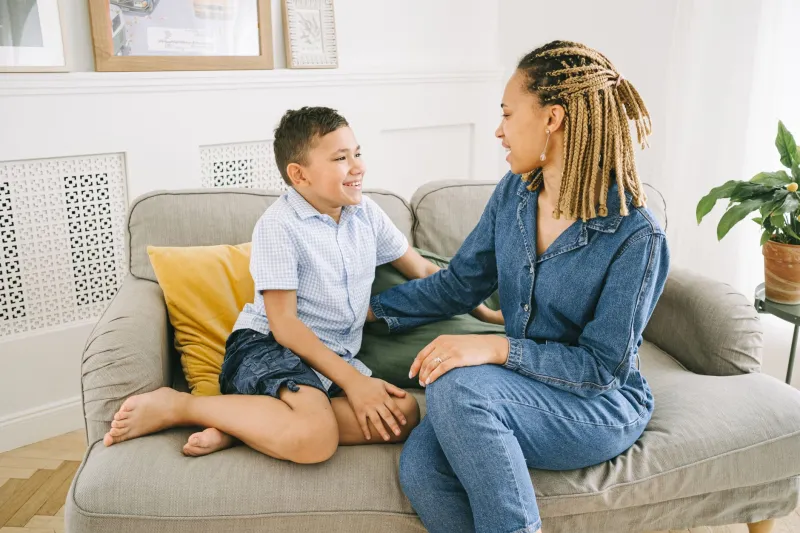
It looks like sitting down next to your kid instead of standing over them. It looks like making eye contact and then not talking for a while. It looks like asking "what happened?" and then — this is the hard part — actually just listening to the answer without layering your interpretation on top of it.
It looks like resisting the urge to say "well, next time you could try..." before the child has even finished processing what this time felt like.
Japanese parents who practice kiki-yaku often use minimal verbal responses — un, un (uh-huh), sō ka (I see), taihen datta ne (that sounds really hard) — to signal presence without redirecting the conversation. These small sounds do something important: they confirm that you're tracking, that you care, without hijacking the narrative.
For American parents, this can feel almost unbearably passive. We're trained to demonstrate love through action. Sitting quietly while your child suffers goes against everything our instincts are screaming at us. But that discomfort? That's worth paying attention to. It might be telling you something about whose needs are really being centered in those moments.
What You Give Up — and What You Get Back
Let's be honest about what this approach costs. When you stay in listening mode, you give up the feeling of having done something. You give up the satisfaction of the fix, the relief of watching your kid's face change when you hand them a solution. That's a real loss. Parents need to feel useful, and problem-solving scratches that itch in a very immediate way.
You also take on more discomfort. Watching your child struggle without swooping in requires a kind of emotional steadiness that doesn't come naturally to most of us, especially when the struggle is painful to witness.
But here's what comes back.
Kids who are regularly given the experience of being listened to without being immediately redirected tend to develop something valuable: the belief that their inner life is worth sitting with. They learn that feelings don't have to be escaped — they can be moved through. They also, over time, start to trust their own problem-solving instincts more, because those instincts have actually been allowed to operate.
And the relationship between parent and child? It changes in a quiet but significant way. When your kid knows that coming to you won't automatically mean getting a lecture or a to-do list, they come to you more. They stay in the room longer. They tell you more of the actual story.
A Small Experiment Worth Trying
You don't have to overhaul your entire parenting philosophy to try this. Start small. The next time your child comes to you upset about something — a friendship falling apart, a disappointment at school, a moment of failure — give yourself a rule: no advice for the first five minutes. Just listen. Ask one or two open questions. Let the silence exist.
See what your kid does with it. See what you do with it.
You might find, like a lot of parents who've stumbled into this approach, that the conversation goes somewhere you didn't expect. That your child arrives at an insight you never would have handed them. That the room gets a little quieter, and somehow also a little closer.
The Japanese have a word for this kind of presence. It doesn't translate perfectly — most of the good ones don't. But it lives somewhere between listening and witnessing, and it turns out that's exactly where a lot of kids need their parents to be.